

The Perspective Lab
What changes when someone else tells the story? Place two accounts beside each other and notice what each brings into view—and leaves out.

The Interstate Highway Demolition of an Urban Neighborhood
A dense, historically Black and immigrant working-class neighborhood of 14,000 residents, 120 small businesses, and 12 churches is condemned and bulldozed to construct an 8-lane elevated Interstate highway connecting white suburbs to the downtown financial core.
The Displaced Resident & Homeowner
The Chief Highway Engineer
Comparing The Displaced Resident & Homeowner with The Chief Highway Engineer.
Mrs. Clara Washington (Age 56, 30-year resident & church deaconess)
They came with clipboards and told us our porch where we raised three generations was 'blight.' They measured our parlor like it was already lumber, gave us a check that won't buy a shed on the other side of town, and said we were standing in the way of progress.
Illustrative voice · not an archival quotation
Arthur Sterling (State Highway Commission)
The metropolitan corridor is suffering from acute circulatory thrombosis. By slicing a clean arterial vector through this substandard grid, we achieve 65 mph uninterrupted freight transit and unlock the economic potential of the entire tri-county basin.
Illustrative voice · not an archival quotation
What comes into view
- Destruction of intergenerational family wealth built through discriminatory redlining.
- Loss of informal eldercare and child-minding networks that made working possible.
- Inadequacy of eminent domain cash appraisals that cannot buy equal housing elsewhere.
What comes into view
- Traffic bottleneck congestion choking metropolitan commercial freight.
- Linear engineering physics requiring minimum curvature radii and grade inclines.
- Utilization of federal 90/10 matching highway trust funds before fiscal expiration.
What falls outside the frame
- Regional metropolitan freight logistics.
- Federal matching grant formulas and suburban commute minutes.
What falls outside the frame
- The invisible social fabric and human psychological devastation of community dispersal.
- Air pollution and asthma rates concentrated on residual fence-line populations.
What matters to this speaker?
Relational integrity, dignity, communal sanctuary.
How far ahead do they look?
50-year intergenerational heritage and ancestral trauma.
What matters to this speaker?
Vehicular throughput speed (vehicles per hour per lane).
How far ahead do they look?
20-year vehicle capacity forecast (1960–1980).
Why perspective changes a telling
Focalization (Gérard Genette, 1972) demonstrates that narrative meaning is determined not by what happens, but by the perceptual filter (the 'focalizer') through which information is restricted, magnified, or erased.
Voice asks who speaks. Focalization asks whose perception frames the account. Neither automatically establishes which claims are true. These examples illustrate differences in attention; they are not empirical findings about real individuals.
The Displaced Resident & Homeowner
Generational memory, mutual aid credit circles, front-porch social safety, uncompensated relational wealth.
Study label: internal focalization
The Chief Highway Engineer
Topographic aerial maps, peak-hour vehicle throughput, straight-line geometric grading, cost-per-mile efficiency.
Study label: external focalization
Scenario context & limitations
Original dataset setting: 1958 Midwestern US Metropolitan Center (Title I Federal Highway Act)
The lab supplies no primary-source record for this particular scenario, its numerical details, or these named speakers. Read it as an illustrative exercise, not a record of a verified event. “Unique observations” compares exact statements in the selected accounts; it is not automated semantic analysis.
Explore the source ledger →The Unreliable Narrator & Alibi Ledger
When a canonical character narrates or edits their own story, what are they hiding from their audience—and how does the surrounding textual apparatus expose the contradiction?
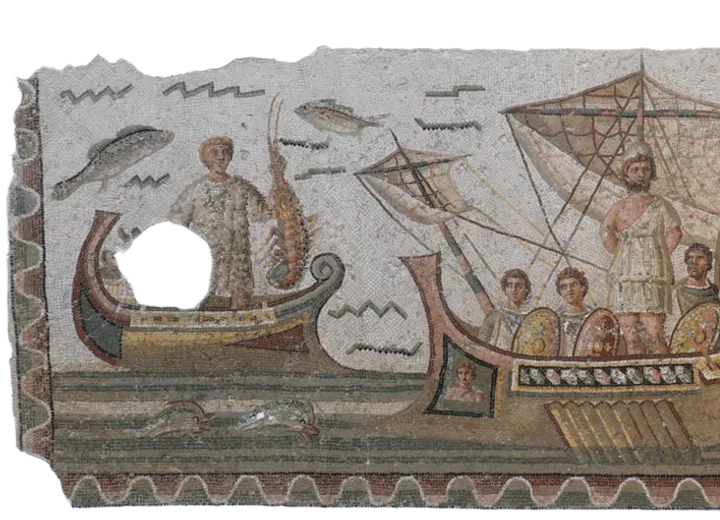
Odysseus at King Alcinous’s Banquet · The Odyssey, Books 9–12 (The Apologoi)
Rhetorical Situation: Shipwrecked naked on Scheria, Odysseus needs King Alcinous to grant him a Phaeacian ship, treasure gifts, and safe passage home—while explaining why all 600 men who sailed under his command are dead.
“My Reckless Crew Opened the Bag of Winds & Ate Helios’s Cattle”
In Books 9–12, Odysseus tells the Phaeacian court that every disaster resulted from either supernatural monsters (Cyclops, Sirens, Scylla) or his crew’s mutinous greed while he was conveniently asleep.
That he was a blameless commander whose men perished through their own impiety, making him worthy of royal Phaeacian hospitality and gold.
Monsters Appear Only Inside Odysseus’s Unwitnessed First-Person Speech
In Books 1–8 and 13–24 (narrated by Homer’s Muse), the Mediterranean has realistic geography and zero monsters—except when Homer notes in Book 1 that Odysseus 'strove to save his comrades, yet could not.' Every monster occurs inside Odysseus’s after-dinner speech.
Homer himself signals the tension: King Alcinous remarks in Book 11 that Odysseus speaks with the craft of a bard rather than a common liar, while in Books 13–19 Odysseus tells five completely fabricated 'Cretan lies' to Athena, Eumaeus, and Penelope.