

NARRATOLOGIUMAtlas of Strands & Meaning
Character Origination, Provenance & Comparative Myth

The Character Origination & Archetype Atlas

Where does a character actually begin? Trace how documented historical records, archaic sanctuary realia, and borrowed myths are transmuted into dramatic characters—and map where later adaptations rewrote public memory.

Origination Atlas9 Dossiers
Illustration of folded paper rooms connected by bridges above a book base.
Illustration · Narratologium
Character Origination & Epistemic Stratigraphy

What’s True, What’s Inspired, What’s Made Up, and What Drifted

Every enduring character is a composite geological stratum: part verifiable historical or material kernel, part borrowed mythic lineage, part authorial dramatic invention, and part later adaptation drift mistaken for the original.

Frankenstein; or, The Modern Prometheus (1818 / 1831) · 1803 Galvanism · 1816 Geneva · 1818 Text · 1931 Cinema

9 Flagship Dossiers · Select any specimen card to load its atlas
01 · What’s True02 · What’s Inspired03 · What’s Made Up04 · Popular Drift
Natural Philosophy & Myth → Concentric Gothic Novel1803 Galvanism · 1816 Geneva · 1818 Text · 1931 Cinema

Frankenstein’s Creature & Victor

Primary Lineage: Mary Wollstonecraft Shelley → Richard Brinsley Peake (1823) → James Whale (1931) · Frankenstein; or, The Modern Prometheus (1818 / 1831)

How 1803 London electro-physiology, an 1814 Rhine castle stop, and Milton’s Paradise Lost became an eloquent Alpine outcast—before 1823 theatre and 1931 cinema bolted his neck and took away his voice.

Signature Operator: Framing / EncapsulationStory ⊂ FrameA metadiegetic story enclosed inside an extradiegetic narrator's perspective.
Three-Stage Visual Provenance Triptych · Material Kernel → Primary Edition → Popular DriftPublic-Domain & Open-Access Museum Plates
PLATE 01 · WHAT’S TRUEKERNEL
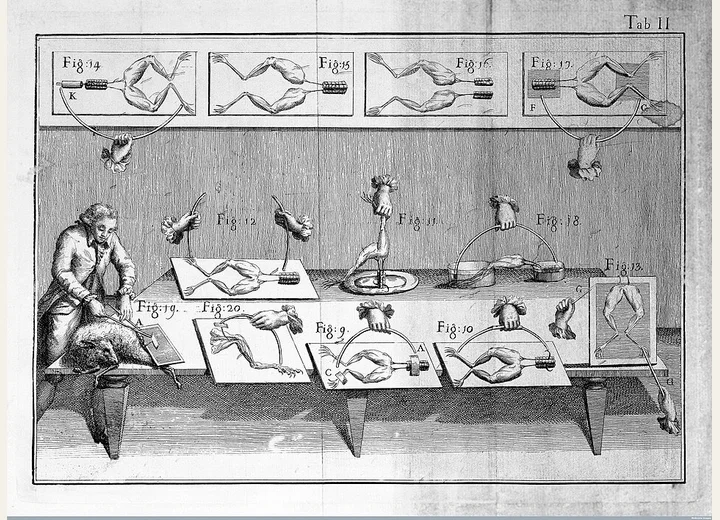
Galvani & Aldini’s Electro-Physiological Plates

Galvani & Aldini’s Electro-Physiological Plates

1791 / 1803 Galvanism · Wellcome Collection / Public Domain

Voltaic piles and metallic arcs stimulating dissected nerves—the documented Romantic-era laboratory science that replaced supernatural necromancy in Shelley’s 1816 discussions.

Museum Record
PLATE 02 · PRIMARY TEXTTEXT
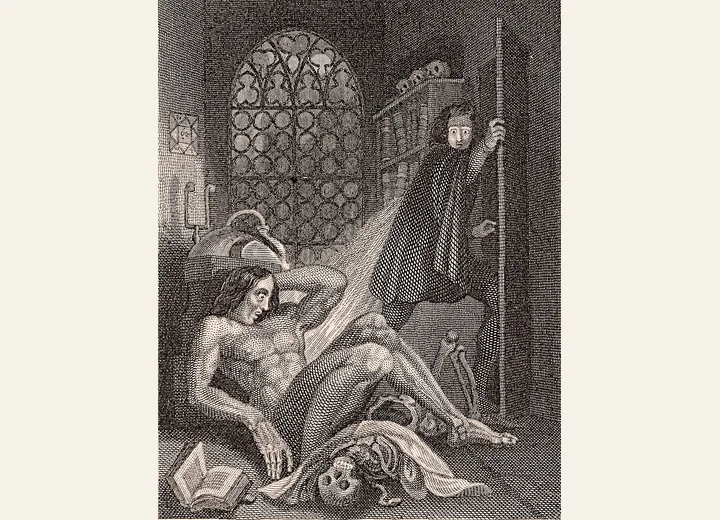
Theodor von Holst’s 1831 Steel-Engraved Frontispiece

Theodor von Holst’s 1831 Steel-Engraved Frontispiece

1831 Frontispiece · Colburn & Bentley Standard Novels (1831) · Public Domain

The very first published illustration of Shelley’s Creature: a long-haired, muscular figure awakening on the floor of a student garret—no bolts, no stitches, no assistant.

Museum Record
PLATE 03 · POPULAR DRIFTDRIFT
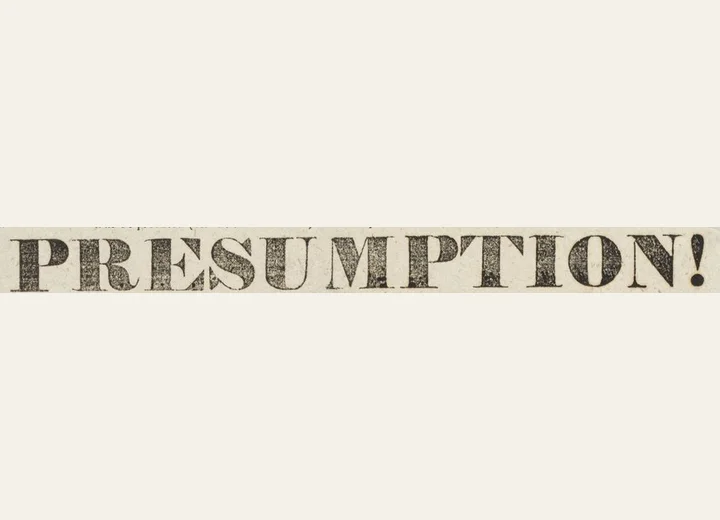
1823 Playbill: Presumption; or, the Fate of Frankenstein

1823 Playbill: Presumption; or, the Fate of Frankenstein

1823 Lyceum Stage Playbill · Harvard Theatre Collection · Public Domain

Richard Brinsley Peake’s 1823 stage melodrama billed the Creature as '——' (played by T. P. Cooke), stripped him of all speech to pass censorship, and added the comic servant Fritz.

Museum Record
Non-Fiction & History Lens
Text → Archive

Tracks documented Romantic-era science:

Giovanni Aldini’s January 1803 galvanic stimulation of executed convict George Forster at the Royal College of Surgeons, Humphry Davy’s chemistry lectures, and the 1816 Mount Tambora volcanic winter at Lake Geneva.

Fiction & Narrative Craft Lens
Archive → Text

Reveals Shelley’s supreme structural decision:

instead of depicting the laboratory assembly in detail, she buries the Creature inside a concentric triple frame (Walton → Victor → Creature) and gives him the most articulate philosophical prose in the novel.

Cartographic Origination & Transmission Atlas6 Provenance Waypoints · Shared Logium TopoJSON Engine

Where the Record Happened, Where the Author Read It, and Where the Story Moved

Pan, zoom, or select any numbered waypoint along Frankenstein’s Creature & Victor to inspect its documentary coordinates, whether the author witnessed the terrain firsthand (solid geodesic arc) or constructed it from library maps (dashed arc), and how later adaptations shifted the canon.

◈Calibrating Logium Natural Earth TopoJSON & Geodesic Arcs…
Epistemic Stratigraphy Ledger

Deconstructing Frankenstein’s Creature & Victor Across Four Strata

Core Question: Where does early-19th-century galvanic science and Miltonic philosophy end, and where does the mute, bolt-necked monster of popular memory begin?

Composite Origination Profile (Editorial Synthesis, Not a Statistical Measurement)Click any segment to isolate stratum
01 · What’s True · 28% SharePrimary Record

1803 Galvanic Demonstrations, 1814 Rhine Journey & 1816 Volcanic Winter

Documented Historical & Material Kernel — What verifiable historical events, real individuals, scientific demonstrations, or physical sanctuary objects anchored the work?
Primary Archival ExhibitPRIMARY ARCHIVE
Record 01 of 3
Galvani & Aldini’s Electro-Physiological PlatesPLATE 01

Giovanni Aldini’s 1803 Newgate Experiment

Nephew of Luigi Galvani publicly applied a voltaic pile to the corpse of executed murderer George Forster in London; the jaw quivered, the left eye opened, and the right hand clenched—discussed directly inside the Godwin-Shelley circle.

Source: Aldini, G. (1803). An Account of the Late Improvements in Galvanism. London.Inspect Plate
+ Inspect 2 additional archival receipts & citations
Receipt #02PRIMARY ARCHIVE

1814 Rhine Stop near Castle Frankenstein

On September 2, 1814, Mary Godwin’s river boat stopped at Gernsheim, two leagues from Burg Frankenstein (associated with 17th-century alchemist Johann Konrad Dippel).

Source: Shelley, M. (1817). History of a Six Weeks’ Tour through a part of France, Switzerland, Germany, and Holland.

Receipt #03MS DIARY / NOTES

July 1816 Firsthand Ascent to the Mer de Glace

During the wet 'Year Without a Summer' caused by Mount Tambora’s eruption, Mary and Percy Shelley traveled to Chamonix and walked the Mer de Glace glacier—the exact terrain where Victor confronts the Creature in Chapter 10.

Source: Shelley, M. Journal entry, July 22–25, 1816; 1831 Introduction.
02 · What’s Inspired · 27% ShareRetrospective Account

Ovid’s Prometheus Plasticator, Milton’s Paradise Lost & Coleridge

Syncretic, Mythic & Literary Lineage — What earlier myths, folkloric motifs, or precursor texts were absorbed and re-commissioned by the teller?

Primary Archival ExhibitPRECURSOR TEXT
Record 01 of 2
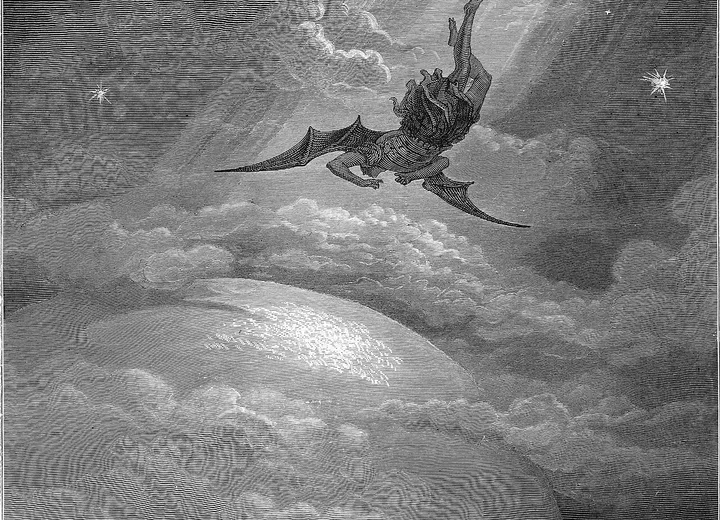
Gustave Doré’s Engraving for Milton’s Paradise LostPLATE 02

Prometheus Plasticator (Ovid & Aeschylus)

The subtitle 'The Modern Prometheus' merges Aeschylus’s fire-stealer (Prometheus Pyrphoros) with Ovid’s Metamorphoses Book I (Prometheus molding humanity from clay and rainwater).

Source: Ovid, Metamorphoses 1.78–88; Byron & Percy Shelley’s 1816 Prometheus poems.Inspect Plate
+ Inspect 1 additional archival receipt & citation
Receipt #02PRECURSOR TEXT

John Milton’s Paradise Lost (1667)

Supplies the novel’s epigraph ('Did I request thee, Maker, from my clay / To mould me Man?') and the Creature’s own moral lexicon when he finds a leather portmanteau in the woods.

Source: Milton, Paradise Lost X.743–745; Frankenstein (1831), Ch. 15.

03 · What’s Made Up · 30% SharePrimary Narrative

The Concentric Frame, 8-Foot Scale & Hovel Self-Education

Authorial Dramatic Invention — What did the author deliberately fabricate, compress, or invert so the character works as a dramatic engine?

Primary Archival ExhibitAUTHORIAL TEXT
Record 01 of 3
Theodor von Holst’s 1831 Steel-Engraved FrontispiecePLATE 03

Deliberate Omission of the Laboratory Formula

Victor explicitly refuses to tell Captain Walton the secret of animation ('I see by your eagerness... that you expect to be informed of the secret with which I am acquainted; that cannot be'), shifting focus from technical how-to to moral abandonment.

Source: Shelley, M. (1831). Frankenstein, Chapter 4.Inspect Plate
+ Inspect 2 additional archival receipts & citations
Receipt #02AUTHORIAL TEXT

8-Foot Stature Chosen for Anatomical Speed

Victor makes the Creature 8 feet tall not for gothic terror, but with a dry anatomical rationale: 'As the minuteness of the parts formed a great hindrance to my speed, I resolved, contrary to my first intention, to make the being of a gigantic stature.'

Source: Shelley, M. (1831). Frankenstein, Chapter 4.

Receipt #03AUTHORIAL TEXT

The De Lacey Hovel & Concentric Focalization

Placing the Creature’s first-person testimony at the center of the novel (Ch. 10–16) forces the reader to hear his eloquent plea for a companion before returning to Victor’s self-justifying frame.

Source: Shelley, M. (1831). Frankenstein, Chapters 10–16.

04 · Popular Drift · 15% ShareScholarly Interpretation

1823 Stage Muteness, 'Fritz' the Assistant & 1931 Universal Iconography

Later Additions Mistaken for Canon — What did later chroniclers, stage plays, translations, or cinema bolt on that public memory now assumes was in the original?

Primary Archival ExhibitSTAGE PLAYBILL
Record 01 of 2
1823 Playbill: Presumption; or, the Fate of FrankensteinPLATE 04

1823 Stage Play: Mute Monster & 'Fritz'

Richard Brinsley Peake’s 1823 melodrama 'Presumption' stripped the Creature (played by Thomas Potter Cooke) of all speech and invented the comic nervous lab assistant Fritz.

Source: Peake, R. B. (1823). Presumption; or, the Fate of Frankenstein. Lyceum Theatre.Inspect Plate
+ Inspect 1 additional archival receipt & citation
Receipt #02CINEMA ARCHIVE

1931 James Whale Film & Jack Pierce Makeup

Introduced Boris Karloff’s flat cranium, neck electrodes (treating the body as an electrical battery), heavy asphalt-spreader boots, and the 'abnormal brain' plot device.

Source: Whale, J. (Dir.). (1931). Frankenstein. Universal Pictures.

Archive ↔ Allembic Transmutation Matrix

How Raw Historical Evidence Was Engineered into Narrative Drama

Where the non-fiction historian and the fiction craftsperson meet: inspect the primary archival record on the left, the formal structural operator in the center, and why the raw record had to be altered to work on the page.

Transmutation Hinge 01

From Galvanic Twitch to Articulate Moral Accuser

Mechanism: Focalization Inversion + Nested Frame
01 · Primary Archival RecordVERIFIED PRIMARY RECORD

Aldini’s 1803 Galvanic Corpse Demonstration

Dated: January 17, 1803 · London

Voltaic stimulation of executed bodies produced only brief involuntary muscular spasms without restoring consciousness or speech.

Discipline: Non-Fiction / Documentary Anchor
Operator →
Framing / EncapsulationStory ⊂ Frame
02 · Narrative TransmutationFICTION ENGINEERING
Why Raw Fact Failed as Drama

A twitching cadaver is a medical curiosity, not a tragic antagonist capable of indicting its creator.

How the Author Transformed It

Shelley skips the electrical mechanics in a single paragraph ('I collected the instruments of life around me') and invests 6 chapters in the Creature’s autodidactic education in language, history, and Milton.

Chapter 10: 'Remember that I am thy creature; I ought to be thy Adam, but I am rather the fallen angel, whom thou drivest from joy for no misdeed.'
Transmutation Hinge 02

From Firsthand Chamonix Glacier Walk to Philosophical Summit

Mechanism: Firsthand Topographical Ballast
01 · Primary Archival RecordAUTHOR WORKING NOTE

Mary Shelley’s Chamonix Journal & Six Weeks’ Tour

Dated: July 1816 · Savoy Alps

Mary and Percy Shelley crossed the Mer de Glace with local guides during the cold, storm-ridden summer of 1816.

Discipline: Non-Fiction / Documentary Anchor
Operator →
Perspective ShiftFocalizer(A) ⇄ Focalizer(B)
02 · Narrative TransmutationFICTION ENGINEERING
Why Raw Fact Failed as Drama

An Alpine travelogue records sublime scenery but lacks dramatic collision.

How the Author Transformed It

Uses the exact granite needles, crevasses, and Montanvert hut she walked in July 1816 as the only stage vast and inhuman enough for creator and creation to parley as equals.

Chapter 10: 'I suddenly beheld the figure of a man, at some distance, advancing towards me with superhuman speed. He bounded over the crevices in the ice, among which I had walked with caution.'
The Foil, Double & Doppelgänger Mirror Atlas

Characters Built as Split Pairs: Victor Frankenstein ↔ The Creature (with Robert Walton as Third Mirror)

Enduring literary figures are rarely solo inventions—they are engineered as dyads where two poles divide a single moral, psychological, or epistemological problem.

“Creator and creation begin as biological opposites and end as psychological twins pursuing each other across the same Arctic ice.”

Collision Site: The Mer de Glace (Mont Blanc, Ch. 10) & The Arctic Pack Ice (Ch. 24)
Pole A · Primary Thesis FigurePromethean Overreacher

Victor Frankenstein

Pole B · Structural Foil / DoubleAbandoned Autodidact & Fallen Angel

The Unnamed Creature

01 · Epistemic Stance
Victor Frankenstein

Ambitious natural philosopher who refuses to disclose his laboratory method even on his deathbed.

The Unnamed Creature

Empiricist tabula rasa who learns language and history through a cottage chink and Milton’s Paradise Lost.

02 · Social Mask vs. Shadow
Victor Frankenstein

Genevan patrician heir surrounded by family affection yet self-isolated by secrecy.

The Unnamed Creature

8-foot surgical composite whose eloquent inner humanity is instantly rejected on sight.

03 · Narrative Voice & Access
Victor Frankenstein

Outer embedded oral confession to Captain Walton (Ch. 1–10, 17–24), which he personally edits in Walton’s log.

The Unnamed Creature

Innermost concentric core (Ch. 11–16)—his words reach us only as quoted by Victor and transcribed by Walton.

04 · Terminal Fate
Victor Frankenstein

Dies exhausted in Walton’s ship cabin still urging the sailors not to turn back.

The Unnamed Creature

Weeps over Victor’s corpse in the cabin and leaps onto an ice-raft toward his own funeral pyre.

Triangulating Third Mirror Node

Captain Robert Walton: The Arctic explorer whose letters enclose both voices—and who is the only one who listens to the warning and turns his ship home.

Popular Memory Collapse Diagnostic

Public memory literally transfers the Creator’s surname ('Frankenstein') onto the unnamed Creature while stripping the Creature of the eloquence that makes him Victor’s intellectual equal.

Cross-Disciplinary Epistemic Switchboard

How Non-Fiction Experts vs. Fiction Experts Solve the Same Character Problem

Both biographers/historians and novelists/dramatists construct human agents out of fragmentary records—but they operate under different evidentiary contracts. Select a problem below to compare their methods side by side.

1. Entering a Character’s Mind (Interiority)

Shared Question: “How do you represent what an agent thought or felt at a decisive moment when no recording device existed inside their head?”

Focalizer(A) ⇄ Focalizer(B)
Non-Fiction Rule (Biographer · Historian · Journalist)CONSTRAINT

Evidence-Bound Inference & Conditional Modality

Cannot fabricate unrecorded inner monologue. Interiority must be anchored to dated letters, diary marginalia, or explicit epistemic qualifiers ('must have wondered', 'according to his later testimony') that keep the evidentiary seam visible.

Specimen: John Adams’s 1770 summation in the Boston Massacre trial: reconstructing soldier panic strictly from acoustic witness depositions rather than invented thoughts.

Fiction Rule (Novelist · Dramatist · Mythmaker)CRAFT LICENSE

Internal Focalization & Free Indirect Discourse (Genette)

Steps directly inside the unrecorded consciousness, dissolving the boundary between narrator and character perception to generate immediate moral and emotional complicity.

Specimen: Mary Shelley granting the Creature the innermost first-person frame (1831 Ch. 10–16) so the reader experiences rejection through the monster’s own syntax before judging his crimes.

Comparative Myth & Structuralist Poetics

Theoretical Role Claims, Critiques & Interactive Systems

Instead of treating archetypes as eternal psychological universals, Narratologium grounds each dramatic role claim in its theoretical tradition, scholarly critiques, and game-system adaptations.

Theorist Tradition: Joseph Campbell (The Hero with a Thousand Faces, 1949)

The Hero / Quest Bearer (Monomyth)

Foundational Text: The Hero with a Thousand Faces (1949) / Adapted by Christopher Vogler (The Writer's Journey, 1992)

Dramatic Function in NarrativeLeaves ordinary world, undergoes supernatural initiation (crossing threshold, belly of whale, atonement with father), and returns with elixir.
Archetype SculptureJoseph Campbell
Illustration of braided paper paths passing through three folio gateways.
Illustration · Narratologium
Canonical Literature Specimens
OdysseusGilgameshLuke Skywalker (Star Wars)Frodo Baggins (Lord of the Rings)
Scholarly Critiques & Limits
  • • Eurocentric and androcentric bias that homogenizes distinct indigenous storytelling traditions into a single solar-myth template.
  • • Omission of collective, non-individualistic heroics and feminist resistance models (e.g. Maureen Murdock's 'The Heroine's Journey').
Interactive Systems (Game Mechanics)
  • • The ubiquitous RPG leveling curve (Level 1 Ordinary Village → Level 99 Cosmic God-Slayer).
  • • Tutorials as Call to Adventure / Refusal of the Call, followed by Dungeon Descent as Belly of the Whale.