

NARRATOLOGIUMAtlas of Strands & Meaning
Stories across media

The Adaptation Graph

Preserved characters, compressed plots, altered endings, transformed settings, and player agency transfer: explore how form shapes narrative meaning.

Adaptation LabCross-Medium
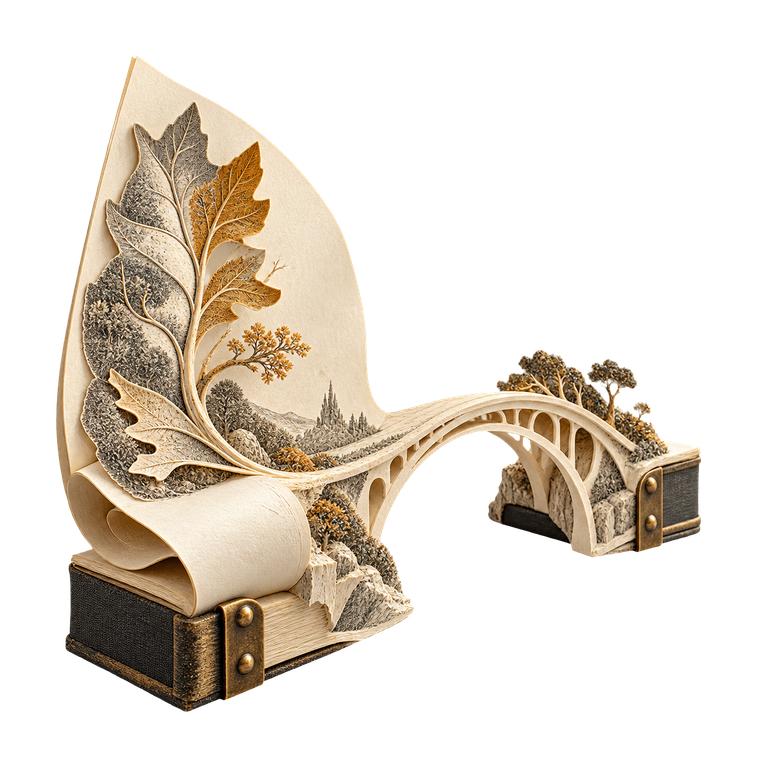
Illustration of a book page transforming from a botanical leaf into a paper bridge.
Illustration · Narratologium
Cross-Medium Adaptation & Iconography LabVictorian Logic Satire → Cel Animation → Stop-Motion → Action RPG

Alice’s Adventures in Wonderland (1865–2000)

Follow Alice across 135 years as Victorian mathematical satire is transformed into Broadway slapstick, Czech stop-motion psycho-horror, and player-controlled survival action.

Victorian Logic Satire → Cel Animation → Stop-Motion → Action RPG

Mutation Matrix // 1865

Alice's Adventures in Wonderland

Creator: Lewis Carroll (Charles Lutwidge Dodgson) & John Tenniel (Illustrations)

Domain: Visual Design
01 · Character Alterations

Original Victorian linguistic satire; characters embody arbitrary logic games, mathematical paradoxes, and schoolroom parodies.

02 · Focalization & Voice Shift

Third-Person free indirect focalization centered on a polite, highly articulate 7-year-old Victorian girl.

03 · Tonal Transformation

Playful linguistic subversion of moralizing Victorian children's literature.

04 · Agency Transfer

Linear textual reader progression; Alice's curiosity drives episodic encounters without an overarching martial quest.

Interdisciplinary Mechanism // Visual Framing

Tenniel's black-and-white cross-hatching established the definitive iconography of the playing-card soldiers and Cheshire grin.

The Character Iconography & Costume Drift Atlas

Author’s Page vs. Public Silhouette: Alice & The Wonderland Ensemble

Why does the public visual image of a character so often contradict the author’s text? Inspect how pragmatic stage mechanics, censorship rules, and magazine illustration created the traits we now mistake for canon.

01 · Authorial / Archaic Portrait on the PagePRIMARY TEXT RECORD
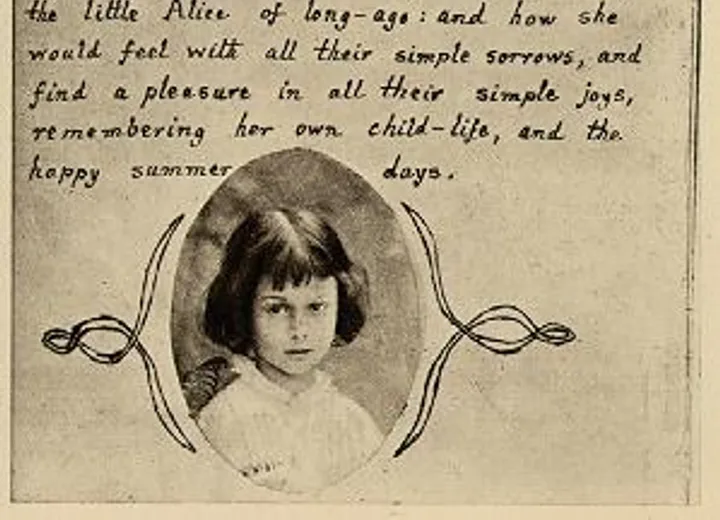
Lewis Carroll’s own 1864 pen-and-ink drawing of dark-haired Alice Liddell in the underground manuscript.

In Charles Lutwidge Dodgson’s 1864 hand-illustrated manuscript ('Alice’s Adventures Under Ground'), Alice has dark, shoulder-length pre-Raphaelite hair inspired by 10-year-old Alice Liddell and wears a loose, unstarched tunic.

Plate: Lewis Carroll’s own 1864 pen-and-ink drawing of dark-haired Alice Liddell in the underground manuscript.

02 · Canonized Public Silhouette (Stage / Print / Cinema)ICONOGRAPHIC DRIFT
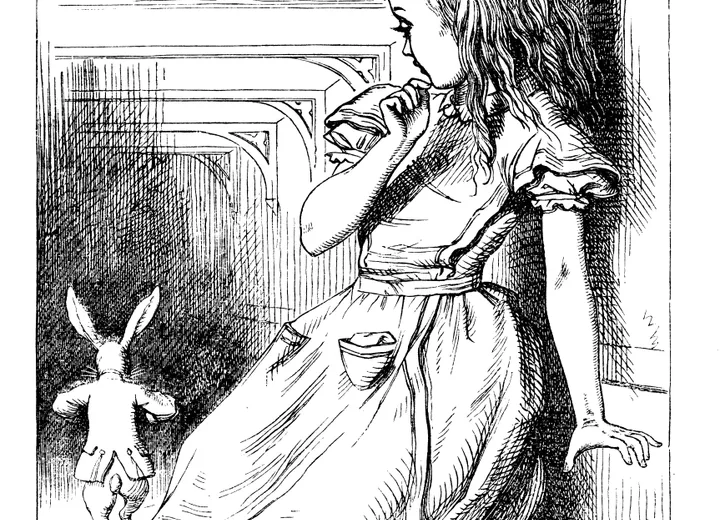
Sir John Tenniel’s 1865 wood-engraved blonde Victorian pinafore & the Hatter’s 10/6 hatband.

Blonde hair held back by an ‘Alice band’ ribbon, crisp blue dress with white pinafore apron, striped stockings, and a Mad Hatter whose top hat carries a '10/6' price tag.

Plate: Sir John Tenniel’s 1865 wood-engraved blonde Victorian pinafore & the Hatter’s 10/6 hatband.

TRAIT 01John Tenniel (1865 / 1871) & Mary Blair / Disney (1951)

Blonde Hair & The 'Alice Band' Ribbon

On the Author’s Page

Real-life prototype Alice Liddell had dark brown hair cut in a short fringe; Carroll never specifies hair color in the printed prose.

Later Visual Invention

Tenniel modeled Alice on blonde Mary Hilton Badcock (and added the hair ribbon in Looking-Glass, 1871), which Walt Disney’s 1951 feature locked in with cornflower blue.

Why the Medium Required It

Wood-engraving required high-contrast light hair so Alice’s head stood out cleanly against dense cross-hatched underground backgrounds.

TRAIT 02Sir John Tenniel (1865 Macmillan Woodcut)

The Hatter’s 'In this style 10/6' Hat Ticket

On the Author’s Page

Carroll’s text never mentions a paper slip in the Hatter’s hat—he isn't even called 'The Mad Hatter' in chapter headings, only 'The Hatter'.

Later Visual Invention

Tenniel drew a haberdasher’s price ticket ('10 shillings and 6 pence') tucked into the hatband to signal that the Hatter is a working Victorian hat-seller wearing his own shop sample.

Why the Medium Required It

Visual cartoon shorthand inherited from Tenniel’s political caricatures for Punch magazine.

TRAIT 03American McGee / Rogue Entertainment (2000)

The Vorpal Blade & Action-Heroine Apron

On the Author’s Page

In Looking-Glass (1871), the 'vorpal sword' belongs to the boy in the nonsense poem 'Jabberwocky', which Alice merely reads aloud from a mirror-book.

Later Visual Invention

Late 20th-century games (American McGee’s Alice, 2000) and cinema hand the Vorpal Blade directly to Alice as her signature weapon.

Why the Medium Required It

Interactive third-person action games require player-directed combat mechanics rather than polite verbal recitation.